Understanding hypo- and hyperresponders—and why your unique biology changes everything.
🎧 ▶️ Press the play button below to listen.
Introduction
For years, the public health message about cholesterol was simple: eat less of it, and your blood levels will drop. This led to a widespread fear of eggs, shrimp, and other cholesterol-rich foods.
However, as with many aspects of nutrition, the reality is far more complex. The relationship between the cholesterol you eat and the cholesterol in your blood is not a simple one-to-one equation.
The human body is a sophisticated machine that tightly regulates its internal environment. When you consume dietary cholesterol, your body adjusts its own production to compensate. For the majority of people, this compensation is quite effective, leading to only a small, and often clinically insignificant, change in blood cholesterol levels.
This explains the common advice that, for most people, dietary cholesterol has minimal effect on the lipid profile on a blood test.
However, this is not the whole story. A significant portion of the population possesses a genetic predisposition that makes them more sensitive to dietary cholesterol. This group, known as hyperresponders, can see a more pronounced increase in their blood cholesterol levels when they consume cholesterol-rich foods.
Understanding this distinction is crucial for anyone trying to manage their cholesterol levels. This article will explore the science behind these individual responses, how you can get a sense of your own reaction to dietary cholesterol, and why this knowledge matters for your health.
The Body’s Cholesterol Economy: The Liver and Gut
To understand why people respond differently to dietary cholesterol, it’s helpful to first identify the body’s main sources of cholesterol. Nearly all the cholesterol circulating in your blood is not from your diet; it is produced internally. This production is shared between two primary organs: the liver and the intestine.
The Liver: The Master Regulator
The liver is the primary site of cholesterol synthesis in the body. It is responsible for about 85% of the steady-state cholesterol in your blood. Hepatocytes, the main type of liver cell, perform a delicate balancing act. They manage cholesterol influx—from both dietary sources and cholesterol recycled from other tissues—against cholesterol loss, which occurs when they release lipoproteins like VLDL and LDL into the bloodstream or convert cholesterol into bile acids for excretion. This system is tightly controlled by complex feedback mechanisms that keep cholesterol levels stable.
The Intestine: The Gatekeeper of Absorption
The intestine plays a crucial role in managing dietary cholesterol. When you eat foods containing cholesterol, it enters the digestive tract. Specialized transporters, such as the Niemann-Pick C1-Like 1 (NPC1L1) protein, facilitate the absorption of cholesterol from the intestinal lumen into enterocytes (intestinal cells). From there, it is packaged into chylomicrons and transported to the liver for processing.
The liver and intestine are in constant communication. When dietary cholesterol is absorbed in the intestine, the liver receives the signal and typically responds by downregulating its own production. A recent study identified a hormone, named Cholesin, which is secreted by the intestine in response to cholesterol absorption and acts on the liver to suppress cholesterol synthesis. This elegant “cross-talk” between the gut and liver is the primary mechanism for maintaining cholesterol homeostasis.
It is within this regulatory system that hyperresponders differ from hyporesponders. For them, this feedback loop seems less effective at adjusting to a high-cholesterol intake.

Hypo- and Hyperresponders: The Epidemiology of a Varied Response
The concept of hypo- and hyperresponsiveness to dietary cholesterol is well established in the scientific literature. It is not a modern discovery; research on this topic dates back decades.
In controlled feeding studies, researchers have consistently observed a wide range of individual responses to the same dietary cholesterol challenge. For instance, a classic dose-response study found that for every additional 100 mg of dietary cholesterol consumed per day, fasting plasma total cholesterol increased by an average of 1.47 mg/dL.
However, this was an average. Individual responses varied, with some seeing little to no change (hyporesponders) and others a significantly larger increase (hyperresponders).
Percentages of Hypo- and Hyperresponders in the Population
Epidemiologically, hyperresponders are estimated to account for approximately 15-25% of the population. This is not a trivial minority. For these individuals, dietary cholesterol can have a clinically meaningful effect on their lipid profile.
Early Dutch studies provided key insights into the nature of this response. In a series of controlled experiments, researchers selected “putative hyperresponders” and “hyporesponders” based on their initial response to a high-cholesterol diet, then retested them.
They found that the response was somewhat consistent over time, confirming that it is a stable individual trait rather than random “chance fluctuations.”
Further research has shown that hyperresponsiveness is likely a polygenic trait, meaning it is influenced by many genes. Variations at the apolipoprotein B (apoB) and lipoprotein lipase (LPL) gene loci have been associated with the consistency and magnitude of the response to dietary changes.
This means some people are genetically predisposed to be more sensitive to dietary cholesterol.
The Metabolic Mechanisms
What is happening inside the body of a hyperresponder? The metabolic processes that differentiate them from hyporesponders are still being investigated. One of the most commonly associated factors is cholesterol absorption efficiency.
Some animal and human studies suggest that hyperresponders absorb a higher percentage of the cholesterol they consume, leading to a greater influx of cholesterol into the liver.
Another study found a “U-shaped” relationship between changes in dietary cholesterol absorption and changes in LDL, underscoring the complexity of the process.
Other mechanisms, such as a higher rate of LDL production by the liver, have also been associated with hyperresponsiveness. Critically, characteristics such as age, sex, and body mass index do not appear to be reliable predictors of hyperresponder status.
Characteristics of Hyperresponders:
- Absorption: May absorb dietary cholesterol more efficiently
- Synthesis: May not fully suppress liver production when dietary intake rises
- Genetics: Variations in genes like apoB and LPL are linked to responsiveness
- Stability: The trait appears consistent over time for individuals
Characteristics of Hyporesponders:
- Absorption: Less sensitive to dietary cholesterol changes
- Compensation: Effectively reduces internal production when dietary intake rises
- Genetics: Not strongly associated with diet-response genes
- Stability: Consistently show little or no change in cholesterol levels in response to dietary cholesterol
While hyperresponders see a rise in LDL, they often also experience a simultaneous increase in HDL (“good”) cholesterol, which may help keep the LDL/HDL ratio stable. This is an important nuance that complicates the simple narrative of “dietary cholesterol is bad.”
How Can You Tell if You Are a Hyperresponder?
Currently, there is no simple at-home test to definitively classify you as a hyper- or hyporesponder to dietary cholesterol. However, with your doctor’s help, there is a practical method you can use to get a clear idea of your personal response. The process requires a bit of detective work and patience.
The Practical Approach: A Dietary “Challenge”
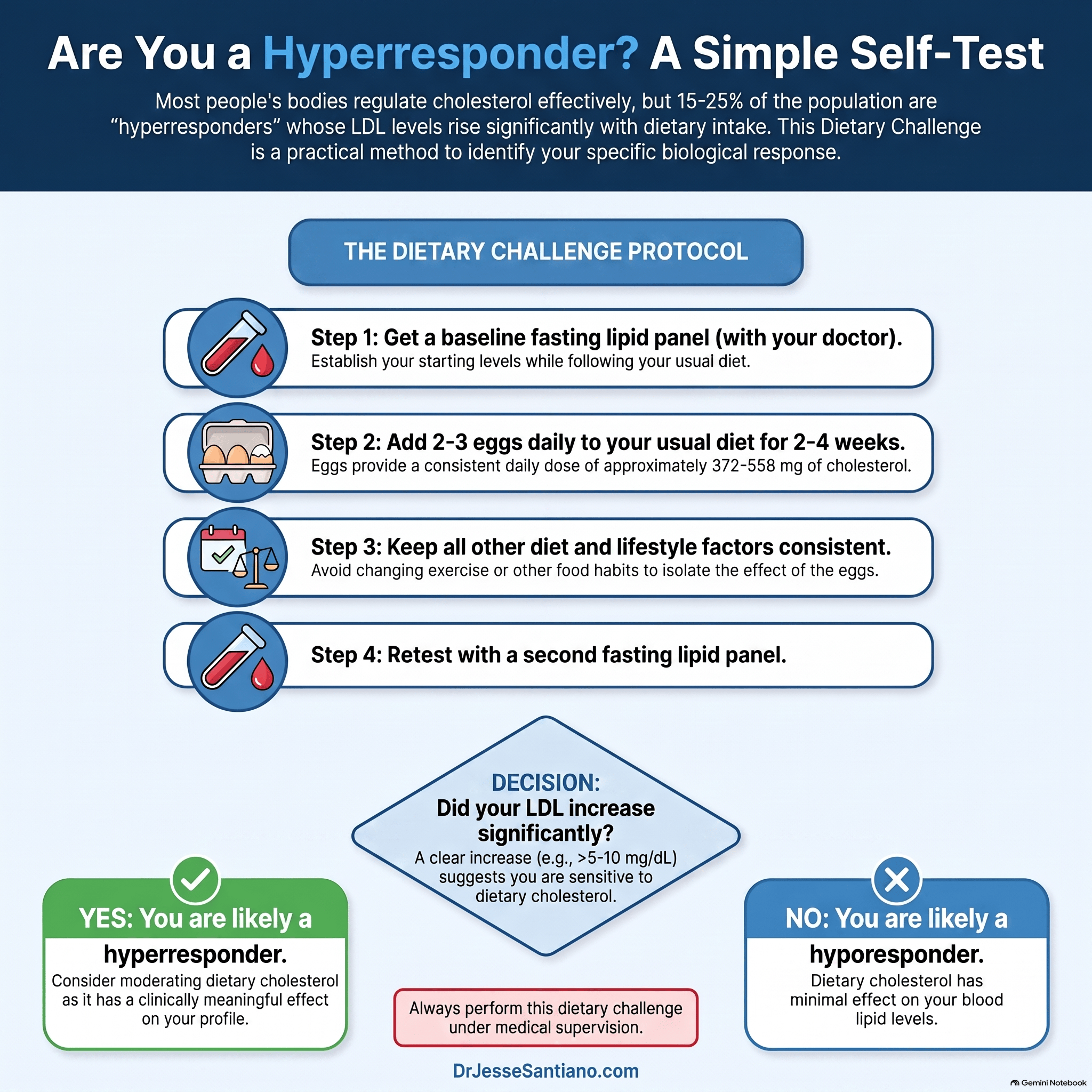
The most reliable way for an individual to assess their responsiveness is through a self-administered dietary challenge, guided by a healthcare professional. Here is how it works:
- Establish a Baseline: Work with your doctor to get a comprehensive fasting lipid panel. This will give you your starting levels of total cholesterol, LDL, HDL, and triglycerides. Ensure you are on your “usual” diet at this time.
- Implement a Controlled Diet: For a period of, say, 2-4 weeks, carefully control your dietary cholesterol intake. The goal is to significantly increase your daily cholesterol consumption. A common and practical way to do this is by adding 2-3 large eggs to your diet every day. Eggs are an excellent choice because their cholesterol content is relatively consistent (about 186 mg per large egg). Ensure the rest of your diet remains as consistent as possible to isolate the effect of the added cholesterol.
- Retest and Analyze: After the dietary challenge period, return to your doctor for another fasting lipid panel. Compare these new results with your baseline numbers.
This personal experiment can tell you a great deal. If your LDL cholesterol does not change significantly—remaining within the normal day-to-day variation—you are likely a hyporesponder.
If, however, you see a noticeable and clear increase (e.g., more than 5-10 mg/dL) in your LDL levels, you have strong evidence that you are a hyperresponder.
It is essential to perform this “test” under the supervision of a physician. They can help you interpret the results, ensure you are not making extreme dietary changes that could be unsafe, and determine the clinical significance of your response in the context of your overall cardiovascular risk.
The Takeaway: A Message for the Health-Conscious Individual
The story of dietary cholesterol and its effect on blood lipids is one of nuance. It is not a simple “good vs. bad” food narrative but a fascinating example of human individuality.
- The average effect of dietary cholesterol is small. For most people, a single egg a day will have a minimal impact on their blood cholesterol levels due to the body’s built-in regulatory system that reduces internal production when dietary intake rises.
- Individual responses vary significantly. Because of genetic factors, approximately 15-25% of the population are “hyperresponders” and will see a more significant rise in LDL cholesterol in response to a high-cholesterol diet.
- Hyperresponsiveness is a stable trait. Your response to dietary cholesterol is not random; it is a consistent characteristic that can be identified through repeated testing.
- There is no simple test to know your status. You can, however, get a strong indication by working with your doctor on a controlled dietary “challenge” and comparing lipid panels before and after the challenge.
- Focus on the bigger picture. For a healthy person, the effect of dietary cholesterol on cardiovascular risk is modest compared to the impact of saturated and trans fats, which have a more well-established, direct effect on raising LDL cholesterol. If you are concerned about your lipid levels, it is wise to pay attention to dietary cholesterol—especially if you suspect you might be a hyperresponder—but it should not be the sole focus of your dietary strategy. The most effective approach is still to prioritize a diet rich in fruits, vegetables, whole grains, lean proteins, and healthy unsaturated fats.
Don’t Get Sick!
About Dr. Jesse Santiano, MD
Dr. Santiano is a retired internist and emergency physician with extensive clinical experience in metabolic health, cardiovascular prevention, and lifestyle medicine. He reviews all medical content on this site to ensure accuracy, clarity, and safe application for readers. This article is for educational purposes and is not a substitute for personal medical care.
💡 Support This Work
Creating well-researched articles, maintaining this website, and keeping the information free takes time and resources.
If you found this article helpful, please consider donating to support the mission of empowering people to live healthier, longer lives, without relying on medications.
🙏 Every contribution, big or small, truly makes a difference. Thank you for your support!
Follow me on Facebook, Gab, Twitter (formerly known as X), Instagram, and Telegram.
Related:
- Your Lipid Tests Recap: What They Mean, How To Improve
- Understanding Your Ferritin: What It Means and How to Improve It
- Understanding Chronic Inflammation And Simple Ways To Reverse It
- How High Fibrinogen Signals Hidden Inflammation And Cardiovascular Risk
- Understanding Homocysteine And Simple Ways To Lower It Naturally
- Understanding FBS, HbA1c, and eAG at a Glance
- Using MPO Testing To Better Understand Cardiovascular Disease Risk
- How Lp-PLA2 Helps Predict Strokes Before They Actually Happen
- Simple Ways To Lower Remnant Cholesterol And Protect Your Heart
- Lower Your Non-HDL Cholesterol Naturally For Better Long-Term Health
- Understanding Your CRP vs Lp(a) To Improve Your Heart Health
- Is Your GGT Too High? Early Warning Signs and How to Lower It
- Understanding Your Ferritin: What It Means and How to Improve It
- The TyG Index: A Powerful Predictor Of Insulin Resistance, Heart Disease Risk And More
- Knowing Your hs-CRP: What It Means and How to Improve It
- Understanding Your ApoB: What It Means and How to Improve It
- Understanding Your Lipoprotein(a): What It Means and How to Improve It
References:
- Katan, M. B., et al. “Characteristics of human hypo- and hyperresponders to dietary cholesterol.” American Journal of Epidemiology, vol. 125, no. 3, 1987, pp. 387–399. https://pubmed.ncbi.nlm.nih.gov/3544818/?dopt=Abstract#1
- “The Effect of Diet on Cardiovascular Disease and Lipid and Lipoprotein Levels.” StatPearls, NCBI Bookshelf, 2024. https://www.ncbi.nlm.nih.gov/sites/books/NBK570127/#4#1#4
- Katan, M. B., et al. “Congruence of individual responsiveness to dietary cholesterol and to saturated fat in humans.” Journal of Lipid Research, vol. 29, no. 7, 1988, pp. 883–892.
- Beynen, A. C., et al. “Sterol balance and cholesterol absorption in inbred strains of rabbits hypo- or hyperresponsive to dietary cholesterol.” Atherosclerosis, vol. 77, no. 2-3, 1989, pp. 151–157.
- Weggemans, R. M., et al. “Apolipoprotein A4-1/2 polymorphism and response of serum lipids to dietary cholesterol in humans.” Journal of Lipid Research, vol. 41, no. 10, 2000, pp. 1623–1628.
- “Reproducibility of the variations between humans in the response of serum cholesterol to cessation of egg consumption.” Atherosclerosis, 1985.
- “A gut-derived hormone regulates cholesterol metabolism.” Cell, 2024.
- “Differences in response to egg-derived dietary cholesterol result in distinct lipoprotein profiles while plasma concentrations of carotenoids and choline are not affected in a young healthy population.” Journal of Clinical Lipidology, 2019.
- Sehayek, E., et al. “U-shape relationship between change in dietary cholesterol absorption and plasma lipoprotein responsiveness and evidence for extreme interindividual variation in dietary cholesterol absorption in humans.” Journal of Lipid Research, vol. 39, no. 12, 1998, pp. 2415–2422.
- “The ABCG5 Polymorphism Contributes to Individual Responses to Dietary Cholesterol and Carotenoids in Eggs.” The Journal of Nutrition, vol. 136, no. 5, 2006, pp. 1161–1165.
- Martin, L. J., et al. “Cholesteryl ester transfer protein and high density lipoprotein responses to cholesterol feeding in men: Relationship to apolipoprotein E genotype.” Journal of Lipid Research, vol. 34, no. 3, 1993, pp. 437–446.
- Katan, M. B., et al. “Existence of consistent hypo- and hyperresponders to dietary cholesterol in man.” American Journal of Epidemiology, vol. 123, no. 2, 1986, pp. 221–234. https://academic.oup.com/aje/article-abstract/123/2/221/57769?login=false
- “A gut-derived hormone regulates cholesterol metabolism.” Cell, 2024.
Disclaimer:
This article is for educational purposes and is not a substitute for professional medical advice, diagnosis, or treatment. Always consult your physician before making health decisions based on the TyG Index or other biomarkers.
© 2018 – 2026 Asclepiades Medicine, LLC. All Rights Reserved
DrJesseSantiano.com does not provide medical advice, diagnosis, or treatment
As an Amazon Associate, I earn from qualifying purchases
Discover more from Don't Get Sick!
Subscribe to get the latest posts sent to your email.