A New 22-Year Study Links TV Watching to Brain Shrinkage—But Here’s What the Science Really Says About Computers, Phones, and Sitting
🎧 ▶️ Press the play button below to listen.
1. Introduction: The Headline That Made Everyone Nervous
In early 2026, a study from the Atherosclerosis Risk in Communities (ARIC) project made waves across health news outlets. Researchers led by Natan Feter at the University of Southern California reported that middle-aged adults who watched television “very often” had significantly smaller brain volumes and more white matter lesions two decades later compared to those who rarely watched.
The finding was striking. It suggested that something as mundane as habitual TV watching—something billions of people do daily—could be silently reshaping our brains as we age.
Unsurprisingly, the internet reacted with a mixture of alarm and confusion. Social media lit up with variations of the same question: “If TV or screen time shrinks my brain, what about my computer? My phone? Am I doomed?”
It’s a fair question. In the modern world, screens are inescapable. We work on them, socialize on them, learn on them, and wind down with them. If television—the original “idiot box”—is actively harming brain structure, does that mean we should abandon all screen-based activities?
The short answer is no. But the long answer is far more interesting—and far more nuanced.
The science that has emerged over the past few years tells a compelling story. It’s not screens that harm our brains. It’s passivity. It’s the what and how of what we do on those screens that determines whether we’re helping or hurting our cognitive health.
Let’s walk through the evidence step by step, answering the questions that naturally arise as we go.
2. The TV Study That Started It All (Feter et al., 2026)
What the Researchers Did
The ARIC study is one of the longest-running epidemiological investigations in the United States. Beginning in 1987, it enrolled nearly 16,000 adults aged 45 to 64 from four U.S. communities. Over the decades, participants returned for repeated health assessments, allowing researchers to track how lifestyle factors in midlife influence health outcomes in old age.
For this particular analysis, Feter and colleagues focused on 1,712 participants who were dementia-free at the time of their brain MRI, which occurred at visit 5 (2011–2013), when participants averaged 76 years old. Crucially, the researchers had data on these individuals’ sedentary behaviors from more than two decades earlier, at visit 1 (1987–1989), when they were in their early 50s.
Television viewing frequency was assessed using a standardized questionnaire. Participants reported how often they watched TV during leisure time, choosing from “Never,” “Seldom,” “Sometimes,” “Often,” or “Very often.”
The researchers also collected data on sitting during work, physical activity levels, smoking, alcohol consumption, body mass index, hypertension, diabetes, and a host of other covariates.
Brain imaging was conducted using 3T MRI scanners, with all data processed centrally using FreeSurfer software. The researchers examined cortical volumes across multiple brain regions, including frontal, temporal, parietal, and occipital lobes, as well as a composite “Alzheimer’s disease signature region” and subcortical structures.
They also measured white matter hyperintensity (WMH) volume—a marker of small vessel cerebrovascular disease that is strongly associated with cognitive decline and dementia risk.
What They Found
The results were clear and, in some ways, alarming:
- Frequent TV watchers had smaller brains. Participants who reported watching TV “Very often” showed significantly lower cortical volume in frontal regions (−0.25 standard deviations), occipital regions (−0.21), and the Alzheimer’s signature region (−0.24) compared to those who watched “Never” or “Seldom.”
- They also had more brain lesions. The same group had significantly higher WMH volume (0.52 standard deviations higher), indicating greater small vessel disease burden.
- The associations were robust. These findings held after adjusting for physical activity, cardiometabolic risk factors, education, occupation, smoking and alcohol use, and numerous other potential confounders. Sensitivity analyses excluding participants with mild cognitive impairment or cerebrovascular disease did not eliminate the associations, suggesting that the relationship wasn’t simply driven by pre-existing brain pathology.
- The effects were widespread but regionally specific. Figure 3 of the paper shows that frequent TV watching was associated with lower volume in the pericalcarine cortex, multiple frontal regions (caudal middle frontal gyrus, superior frontal gyrus), limbic areas (isthmus cingulate, posterior cingulate cortex, rostral anterior cingulate), and subcortical structures including the thalamus and pallidum.
Men appeared more vulnerable. In sex-stratified analyses, the associations were largely driven by males. Women showed fewer significant brain-volume associations with TV watching, though the White Matter Hyperintensity findings were consistent across sexes.

How Much Shrinkage Are We Talking About?
If you’re like most readers, you’re probably asking: “Okay, but how much shrinkage is that, really? 5%? 10%? What does a ‘0.25 standard deviation’ mean in real terms?”
That’s a fair question.
The study itself does not report brain volumes in cubic centimeters, so we cannot give an exact percentage. However, we can make a rough estimate based on typical brain volumes in older adults from other studies.
Here’s the math:
- Average frontal lobe volume in older adults is roughly 440 cm³, with a standard deviation of about 50 cm³.
- A 0.25 SD reduction equals approximately 12.5 cm³ (0.25 × 50 cm³).
- 12.5 cm³ is about 2.8% of 440 cm³.
Applying the same logic to other regions:
| Brain Region | Effect Size (SD) | Estimated Reduction |
|---|---|---|
| Frontal lobe | −0.25 | ~3% |
| Occipital lobe | −0.21 | ~3% |
| Alzheimer’s signature region | −0.24 | ~5% |
Important caveat: These are rough estimates based on typical brain volumes in aging populations, not direct measurements from the ARIC study. The actual percentages may vary. The study itself only reports standard deviations.
What we can say with confidence: Frequent TV watching was associated with a statistically significant reduction in brain volume that is clinically meaningful—roughly equivalent to 1-2 decades of accelerated aging in those specific regions.
The more concerning finding: White matter hyperintensities—a marker of small vessel disease—were approximately 52% higher in frequent TV watchers (0.52 SD). This suggests that the vascular damage from passive TV watching may be more significant than the gray matter loss.
The Takeaway from Feter et al.
This study provides compelling longitudinal evidence that passive, cognitively undemanding screen-based activity—specifically television watching—is associated with adverse brain structural outcomes over two decades. The effect sizes, while modest, are clinically meaningful, particularly for the Alzheimer’s signature regions and WMH burden.
But this immediately raises a critical question…
3. The Natural Follow-Up: What About Computers? (Raichlen et al., 2022)
“Okay, TV is bad for my brain. But I work on a computer all day. Is that also shrinking my brain?”
This is the most common and most reasonable question a reader will ask after digesting the Feter et al. findings. After all, for many people, the majority of their waking hours are spent in front of a computer screen, whether for work, study, or leisure. If all screen time were equally harmful, we would be facing a public health crisis of unprecedented proportions.
Fortunately, the evidence tells a very different story.
The UK Biobank Study
Just four years before Feter et al. published their ARIC findings, a landmark study led by David Raichlen—who is also a co-author on the Feter paper—analyzed data from the UK Biobank, one of the largest and most comprehensive health databases in the world. The study included over 500,000 participants aged 37 to 73, with a median follow-up of nearly 12 years.
The researchers examined two distinct types of leisure-time sedentary behavior: TV watching and computer use (defined as using a computer outside of work). They then assessed the association of each with incident all-cause dementia.
The Surprising Finding
The results were dramatic and, in some ways, counterintuitive:
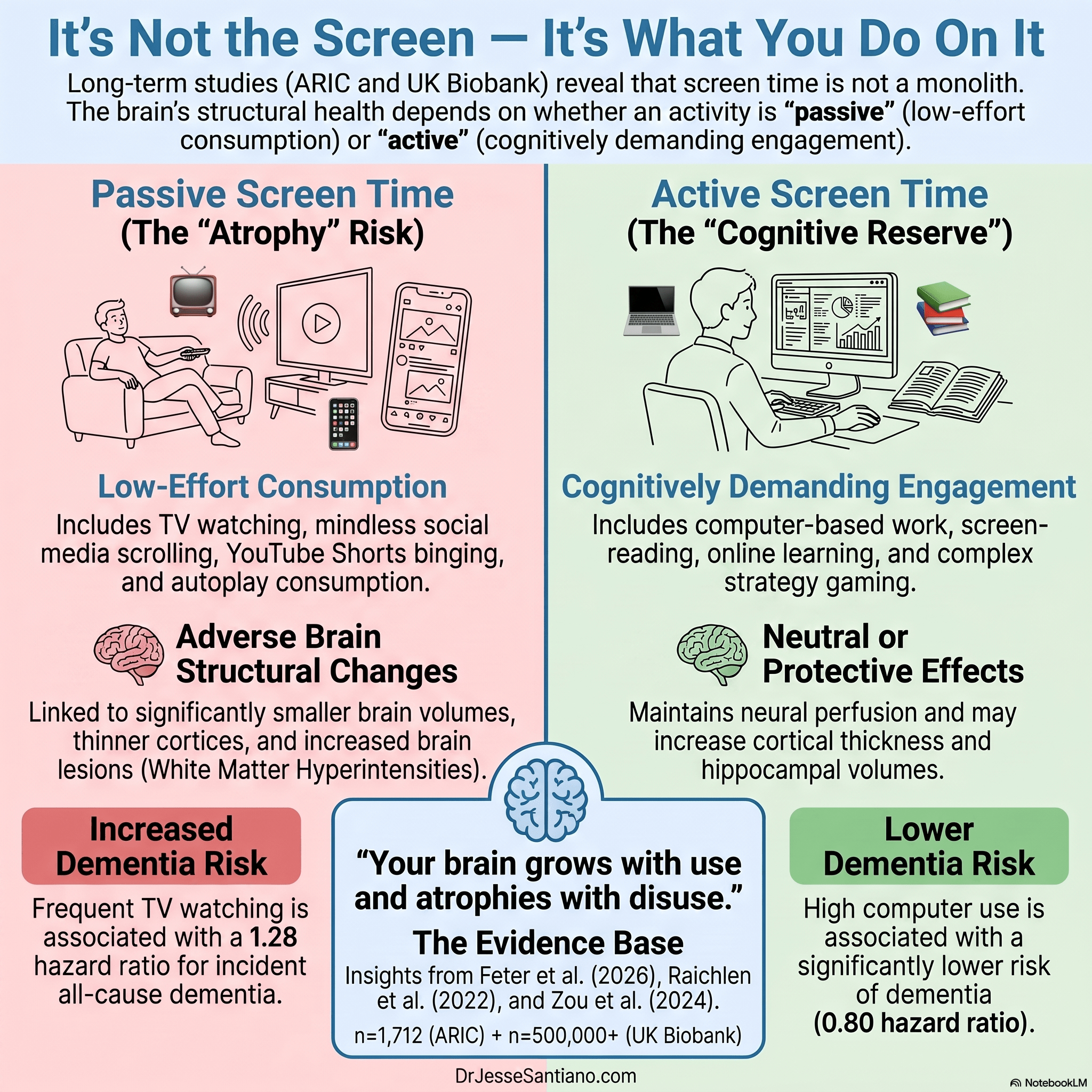
- TV watching was associated with a significantly higher risk of dementia (hazard ratio of approximately 1.28 for high TV viewing compared to low TV viewing). This aligns perfectly with the structural brain findings from Feter et al.
- Computer use showed the opposite pattern. Higher computer use was associated with a lower risk of dementia (hazard ratio of approximately 0.80 for high computer use compared to low use). This protective association persisted even after adjusting for physical activity and a wide range of confounders.
In other words: TV watching and computer use had diametrically opposed relationships with dementia risk. One was harmful; the other was protective.
Why the Difference?
Raichlen and colleagues proposed a compelling explanation: the cognitive demands of the two activities are fundamentally different.
Television watching, particularly in the modern era of streaming and binge-watching, is largely passive. It requires minimal cognitive engagement. The narrative unfolds without the viewer’s active participation. There is no problem-solving, no decision-making, no active information processing—just consumption.
Computer use, by contrast, is typically active and cognitively engaging. Whether you’re writing emails, analyzing data, creating presentations, reading articles, learning a new skill, or even playing complex strategy games, computer use involves sustained attention, working memory, problem-solving, and often social interaction. These cognitive demands engage neural networks in ways that may promote brain health rather than degrade it.
This finding is consistent with the growing body of research on “cognitive reserve”—the idea that mentally stimulating activities throughout life build a buffer against age-related brain changes and dementia. Computer use, as a cognitively demanding activity, may contribute to this reserve.
What About Phones?
The Raichlen study didn’t explicitly examine cell phone use, largely because the UK Biobank data collection began before smartphones were ubiquitous. However, the underlying principle applies to phones as well: the effect depends entirely on how you use them.
If you use your phone for active learning, reading, problem-solving, or meaningful communication, the evidence suggests it falls into the “protective” category.
If you use it for passive scrolling, mindless video watching, or hours of social media consumption, the passive nature of the activity likely places it closer to the “harmful” category.
This leads us to a more refined question…
4. Adding Nuance: Passive vs. Active Screen Content (Zou et al., 2024)
“Wait—so if I watch an educational documentary on TV, is that still harmful? And if I scroll mindlessly through TikTok on my phone, is that just as bad as TV?”
This is exactly the kind of sophisticated question a well-informed reader will ask. It’s also precisely the question that the research community has been grappling with.
The Emerging Consensus
A major 2024 review published in Trends in Cognitive Sciences by Zou and colleagues synthesized the growing body of evidence on sedentary behavior and brain health. The authors proposed a crucial distinction that resolves the apparent contradiction between TV watching and computer use.
They divided screen-based sedentary behaviors into two categories:
Passive Sedentary Behaviors:
- Television watching
- Mindless scrolling on social media
- Binge-watching streaming content
- Video content consumption without active engagement
- Listening to background media without attention
Active Sedentary Behaviors:
- Computer use for work or learning
- Reading (including on screens)
- Playing complex video games
- Online courses and educational activities
- Engaged social interaction via digital platforms
- Creative digital activities (writing, coding, designing)
What the Evidence Shows
Zou and colleagues systematically reviewed the neuroimaging evidence across dozens of studies and found a consistent pattern:
Passive sedentary behaviors were consistently associated with:
- Reduced gray matter volume in key brain regions
- Thinner cortical thickness, particularly in frontal and temporal areas
- Greater white matter hyperintensity burden
- Poorer cognitive performance across multiple domains
Active sedentary behaviors showed either:
- No association with adverse brain outcomes, or
- Positive associations, including greater cortical thickness and larger hippocampal volumes in some studies.
The review also highlighted a potential mechanism: passive behaviors are associated with reduced cerebral blood flow, while active engagement maintains or even enhances neural perfusion and synaptic plasticity.
The Content of the Content Matters
This framework suggests that watching a high-quality documentary may be less harmful than binge-watching a reality TV show, but it still lacks the active cognitive engagement of reading a book or solving a problem.
The key variable isn’t the informational value of the content—it’s the cognitive effort required to process it.
Similarly, using your phone to read an article, learn a language through an app, or engage in a thoughtful text conversation is fundamentally different from passively scrolling through an infinite feed of short videos. One exercises your cognitive faculties; the other does not.
Practical Implications
For the average person, this means several things:
- Not all screen time is created equal. The device matters less than what you’re doing with it.
- Replace passive consumption with active engagement. Read instead of watch. Discuss instead of browse. Learn instead of scroll.
- Be intentional about digital media. Mindset matters—if you watch television with active engagement (analyzing, questioning, discussing), you may mitigate some of the passive effects.
But this raises one more question—perhaps the deepest one of all…
5. The Deeper Mechanism: Is It the Sitting or the Screen? (ARIC Accelerometer Data)
“Is the brain shrinkage actually due to the sitting? Would I get the same effects if I sat and read a book for four hours versus watching TV for four hours?”
This is the most sophisticated question a reader can ask, and it cuts to the heart of the scientific debate. The Feter et al. study was about TV watching, but TV watching also involves sitting. How do we disentangle the effects of sedentariness from the effects of cognitive passivity?
The ARIC Accelerometer Study
Recall that the ARIC study—the same cohort that gave us the Feter et al. findings—also conducted an ancillary study using accelerometers to objectively measure physical activity and sedentary time. Raichlen and colleagues (including several co-authors from the Feter paper) published this analysis in 2024.
The researchers equipped a subset of ARIC participants with hip-worn accelerometers to measure their actual movement patterns. They then examined the relationship between device-measured sedentary time and white matter hyperintensity volume.
The Findings
The results were revealing:
- Greater total sedentary time (measured objectively by accelerometers) was associated with higher WMH volume—the same marker of small vessel disease that was elevated in frequent TV watchers.
- However, the strength of this association depended heavily on physical activity levels. The link between sedentary time and WMH was strongest in participants who engaged in low levels of moderate-to-vigorous physical activity. Among those who were more physically active, the association was weaker or non-existent.
- Crucially, the association between sitting and brain health was not uniform across all contexts. In the Feter et al. paper itself, sitting at work—which is also sedentary behavior—showed the opposite association: occupational sitting was linked to higher cortical volumes in several brain regions.
The Occupational Sitting Paradox
This is a fascinating and often-overlooked finding from Feter et al.:
Participants who reported “Always” sitting during work showed:
- Higher frontal, parietal, and occipital cortical volumes
- Lower WMH volume (i.e., fewer brain lesions)
Compare this to the TV findings, and you have a paradox: both activities involve sitting, but one is associated with brain shrinkage while the other is associated with larger brain volume.
Resolving the Paradox
The resolution lies in understanding that sedentariness and cognitive engagement are independent dimensions.
- Occupational sitting typically involves active problem-solving, communication, decision-making, and sustained attention—all of which may promote brain health through cognitive stimulation, even if they involve sitting.
- TV watching typically involves minimal cognitive engagement, while simultaneously exposing the viewer to prolonged postural immobility.
The ARIC accelerometer data confirms that the duration of sedentary time matters—but it’s not the whole story. The context and content of that sedentary time modify the relationship. Sitting while engaged in cognitively demanding work appears to be neutral or even beneficial; sitting while passively consuming media appears harmful.
The Physiological Mechanisms
Research has identified several mechanisms through which sedentary behavior—particularly passive sedentary behavior—may affect brain structure:
- Cerebral blood flow: Prolonged sitting reduces cerebral blood flow and may impair the delivery of oxygen and nutrients to neural tissue.
- Metabolic dysfunction: Sedentariness promotes insulin resistance, inflammation, and endothelial dysfunction—all of which affect cerebrovascular health.
- Reduced neurotrophic factors: Physical inactivity is associated with lower levels of brain-derived neurotrophic factor (BDNF), which supports neuronal survival and plasticity.
- Increased vascular risk: Sedentary behavior contributes to hypertension, diabetes, and obesity—all established risk factors for both white matter disease and cortical atrophy.
- Lack of cognitive stimulation: Passive screen time does not activate the neural networks involved in learning, memory, and executive function, potentially leading to use-dependent atrophy.
Importantly, these mechanisms are not mutually exclusive—and they may interact. Passive TV watching involves both physical inactivity and cognitive under-stimulation, creating a “double hit” that may be particularly harmful.
6. Conclusion: What This Means for You
Let’s summarize what the science actually says:
The Simple Answer
TV watching—especially frequent, passive viewing—is associated with smaller brain volumes and more white matter lesions two decades later. This was the core finding of Feter et al. (2026).
The Nuanced Answer
Screen time is not inherently harmful. Computer use—which is typically cognitively demanding—shows the opposite association, being linked to lower dementia risk (Raichlen et al., 2022). The key variable is not the device but the cognitive engagement during use.
The Refined Nuance
Passive content consumption (mindless TV, scrolling, binge-watching) is associated with reduced gray matter and thinner cortices. Active content engagement (reading, learning, problem-solving, complex gaming) is associated with either neutral or positive brain outcomes (Zou et al., 2024).
The Deepest Insight
The sitting itself is part of the picture, but not the whole picture. Occupational sitting, when cognitively engaging, is actually associated with larger brain volumes. The combination of physical inactivity and cognitive passivity—the TV-watching package—appears uniquely harmful (ARIC accelerometer data).
Practical Recommendations
Based on the evidence, here are actionable steps for protecting brain health:
- Replace passive screen time with active engagement. If you’re going to be on a screen, use it to learn, create, or solve problems rather than just consume. Read articles, take online courses, write, code, or engage in strategic games.
- Be intentional about television. If you watch TV, consider watching documentaries that provoke thought, or engage actively by discussing what you’ve seen, taking notes, or analyzing plot structures and themes. Turn passive consumption into active engagement.
- Break up prolonged sitting. The accelerometer data shows that sedentary time is most harmful when it’s unbroken. Stand, stretch, or walk every 30 minutes. Even small movements interrupt the negative physiological cascade of prolonged sitting.
- Incorporate physical activity. Physical activity appears to buffer some of the harmful effects of sedentary time. Aim for at least 150 minutes of moderate-intensity activity per week.
- Cultivate a variety of stimulating activities. Don’t rely on a single source of cognitive engagement. Read books, have conversations, play musical instruments, learn languages, engage in hobbies that require fine motor skills and problem-solving.
- Be mindful of your phone habits. The same principles apply. Use your phone for active purposes—reading, learning, meaningful communication—rather than passive scrolling. Set limits on social media and video consumption.
Final Thought
The Feter et al. study is an important contribution to our understanding of how lifestyle factors in midlife shape brain health in older age. But it should not be read as a condemnation of all screen time. The brain is remarkably plastic—it adapts to what we do with it.
Passive, cognitively undemanding screen time appears to contribute to brain changes that may increase vulnerability to cognitive decline. Active, cognitively engaging screen time appears neutral or even protective. The device is irrelevant; the activity is everything.
The science is clear: your brain grows with use and atrophies with disuse. The screens in our lives are tools—powerful ones. How we wield them determines whether they help us flourish or leave us diminished.
Choose wisely. Your brain will thank you decades from now.
Don’t Get Sick!
About Dr. Jesse Santiano, MD
Dr. Santiano is a retired internist and emergency physician with extensive clinical experience in metabolic health, cardiovascular prevention, and lifestyle medicine. He reviews all medical content on this site to ensure accuracy, clarity, and safe application for readers. This article is for educational purposes and is not a substitute for personal medical care.
💡 Support This Work
Creating well-researched articles, maintaining this website, and keeping the information free takes time and resources.
If you found this article helpful, please consider donating to support the mission of empowering people to live healthier, longer lives, without relying on medications.
🙏 Every contribution, big or small, truly makes a difference. Thank you for your support!
Follow me on Facebook, Gab, Twitter (formerly known as X), Instagram, and Telegram.
Related:
- 7000 Steps Can Save Your Heart, Brain, And Prolong Life
- Periodontitis The Gum–Heart–Brain Connection: A Silent Warning System
- Lithium: How This Simple Mineral Shapes the Brain and Protects Against Suicide
- Lost In The Maze: How Junk Food Weakens Your Brain’s GPS
- How Ultra-Processed Foods Alter the Brain and Fuel Disease—And How to Stop It
- How Cold Exposure Strengthens Your Heart, Brain, And Resilience Naturally
- Strokes Associated with COVID-19 vaccines
- Simple Daily Choices That Cut Heart Attack And Stroke Risks
- Medications And Ischemic Preconditioning: The Helpers And The Blockers
- Do Statins Starve the Brain? A Hidden Risk Behind Brain Fog
- Restore Brain Power And Energy With Methylene Blue
- The Surprising Way Exercise Protects The Brain from Sugar
- Natural Preconditioning: Build Heart and Brain Resilience Every Day
- Lithium Controls Inflammation: Protecting Mood, Brain And Body Health
- Unlocking Music and Brain Health: Secrets to Aging Better
- Reverse Pandemic Brain Aging With These Powerful Daily Habits
- How Exercise Improves Brain Health in Children with Obesity
- Methylene Blue And Photobiomodulation Supercharge Your Brain’s Energy
- Unlock Hidden Brain Power: Creatine’s Mental Edge Revealed
- Discover Hidden Brain Aging Signs You Must Address Now
- How Cold Exposure Strengthens Your Heart, Brain, And Resilience Naturally
- Sleep’s Hidden Power: Glymphatics Shield Your Brain From Dementia
References:
- Feter, N., Nanda, A., Hourihan, S., et al. (2026). Associations of distinct sedentary behaviors with cortical, subcortical, and white matter hyperintensity volumes: Evidence from the ARIC study. Alzheimer’s & Dementia, 22, e71582.
- Raichlen, D. A., Klimentidis, Y. C., Sayre, M. K., et al. (2022). Leisure-time sedentary behaviors are differentially associated with all-cause dementia regardless of engagement in physical activity. Proceedings of the National Academy of Sciences, 119(35), e2206931119.
- Raichlen, D. A., Ally, M., Aslan, D. H., et al. (2024). Associations between accelerometer-derived sedentary behavior and physical activity with white matter hyperintensities in middle-aged to older adults. Alzheimer’s & Dementia, 16(3), e70001.
- Zou, L., Herold, F., Cheval, B., et al. (2024). Sedentary behavior and lifespan brain health. Trends in Cognitive Sciences, 28(4), 369-382.
Disclaimer:
This article is for educational purposes and is not a substitute for professional medical advice, diagnosis, or treatment. Always consult your physician before making health decisions based on the TyG Index or other biomarkers.
© 2018 – 2026 Asclepiades Medicine, LLC. All Rights Reserved
DrJesseSantiano.com does not provide medical advice, diagnosis, or treatment
As an Amazon Associate, I earn from qualifying purchases
Discover more from Don't Get Sick!
Subscribe to get the latest posts sent to your email.