🎧 ▶️ Press the play button below to listen.
Introduction
This article is about statins and arterial calcifications. Statins reduce heart attacks and cardiovascular death. That part is not in dispute.
But something strange happens when you scan the arteries of people taking statins. Their calcium scores often go up.
This creates a genuine paradox. If calcium in the arteries is bad, why would a drug that prevents heart attacks increase it?
The answer may surprise you: a rising calcium score on a statin might not be a sign of worsening disease. It might be a sign that the plaque is getting safer.
Let’s break this down.

What We Know About Statins and Calcium Scores
The Observational Data
Study after study has shown that people taking statins tend to have higher coronary artery calcium scores than people not taking them.
A 2023 review of 41 studies found that statin users had higher calcium scores and were more likely to have any calcification. This pattern has been seen across many different patient groups.
But there is a catch. These are observational studies. They cannot prove cause and effect. People who take statins are different from people who don’t—they tend to be older, sicker, and at higher risk to begin with.
What Randomized Trials Show
Randomized controlled trials—the gold standard of medical evidence—tell a more complicated story.
The same 2023 review found that, when considering only randomized trials, the effect of statins on calcium scores did not reach statistical significance. The results varied depending on how calcium was measured and how long patients were followed.
One important finding: the effect appears to be dose-dependent and time-dependent. Higher doses and longer treatment lead to more calcium progression.
So what does this mean?
The honest answer is: the evidence is mixed. But the pattern suggests that statins may indeed increase calcium scores in some patients, particularly at higher doses and over longer periods.
Why Might Statins Increase Calcification?
Several mechanisms have been proposed. None of them is definitively proven, but they offer plausible explanations.
The Immune Cell Pathway
One well-studied mechanism involves immune cells called macrophages.
Macrophages normally help keep inflammation in check and prevent too much calcium from building up in plaque. A 2020 study found that statins interfere with a specific signaling system inside these cells. This interference appears to disable one of the body’s natural brakes on calcification, leading to more calcium deposits.
Think of it this way: statins may accidentally turn off a safety switch that normally keeps calcium out of plaque.
The Vitamin K Connection
Another hypothesis involves vitamin K2.
The body needs vitamin K2 to activate a protein called matrix Gla protein (MGP). MGP acts like a security guard that keeps calcium out of artery walls. Without enough active MGP, calcium can slip into the plaque more easily.
Some researchers believe statins may reduce vitamin K2 levels, weakening this protection.
This remains a hypothesis, not an established fact. But it is biologically plausible.
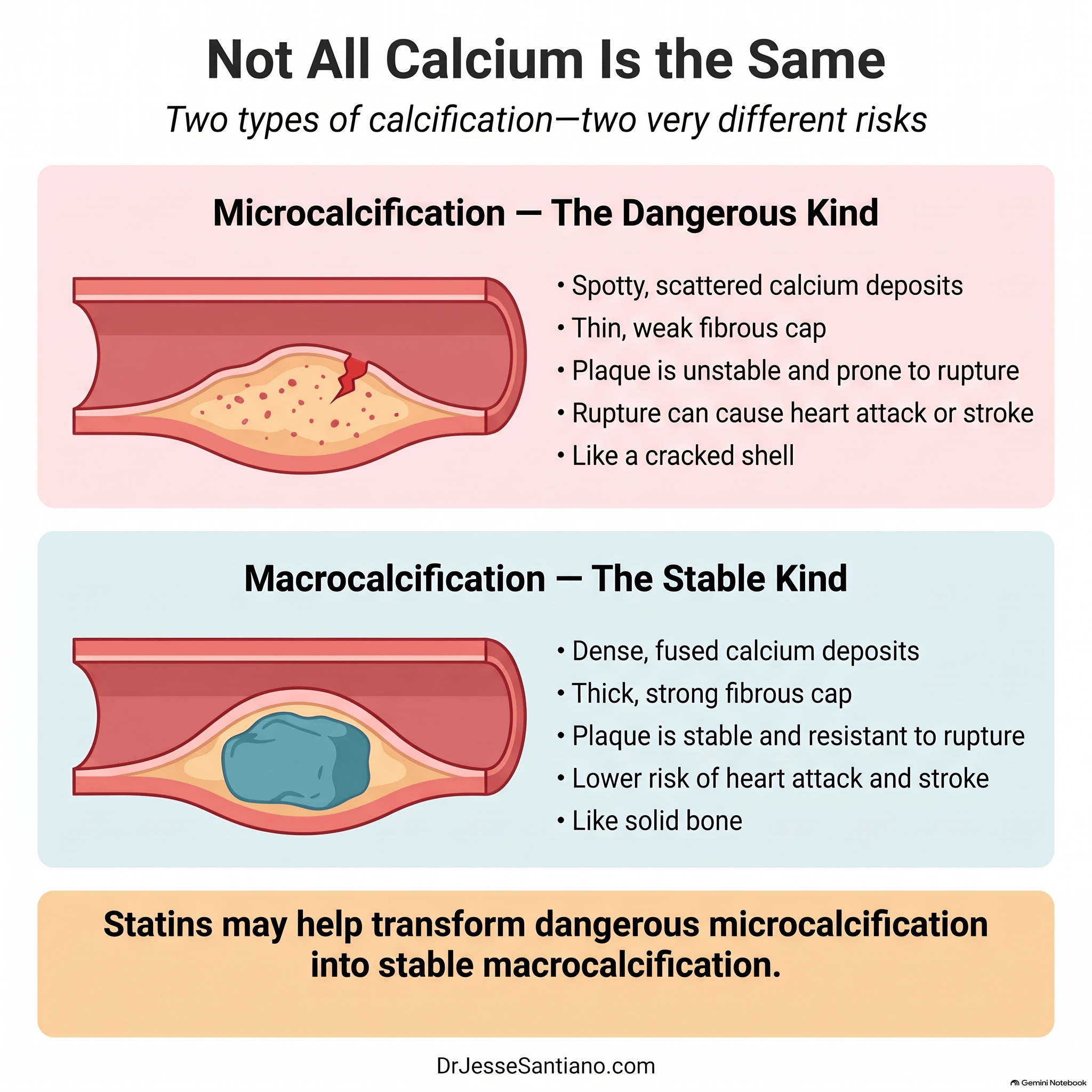
Not All Calcium Is the Same
Here is a crucial distinction that many people miss.
There are two types of calcium in plaque:
Spotty, scattered calcium (microcalcification) — This is the dangerous kind. It makes plaque unstable and more likely to rupture, like a cracked shell.
Dense, fused calcium (macrocalcification) — This is the stable kind. It makes plaque hard and tough, like solid bone, and much less likely to break apart.
Statins may help transform dangerous, spotty calcium into stable, dense calcium. If that is true, then a rising calcium score does not mean the plaque is getting worse—it may mean the plaque is getting safer.
The Plaque Stabilization Hypothesis
This brings us to the most important idea in this article.
What If Rising Calcium Is Good?
If statins transform dangerous soft plaque into stable calcified plaque, then a rising calcium score could actually be a sign that treatment is working.
This idea is supported by imaging studies. When researchers use intravascular ultrasound to examine arteries, they find that statins reduce the total plaque volume, shrink the lipid core, and thicken the fibrous cap—all signs of stabilization. At the same time, calcium density increases.
In other words, the plaque is becoming smaller in volume but denser in calcium. It is transforming from a vulnerable, rupture-prone lesion into a stable, calcified scar.
The “Healing” Interpretation
A 2025 review in JACC: Advances put it this way: “CAC progression under lipid-lowering therapy does not equate to therapeutic failure; instead, it may represent structural healing” .
Under this interpretation, a rising calcium score on a statin is not a warning sign. It may be evidence that the drug is doing exactly what it should—turning a dangerous plaque into a harmless one.
Risk Compensation—When Statins Become an Excuse
There is another important issue to discuss, and it has nothing to do with biology.
It has to do with human behavior.
The “I’m on a Statin, So I Can Eat What I Want” Problem
Some people who start taking statins develop a dangerous mindset: they believe the medication gives them a free pass to ignore healthy habits.
This is called risk compensation. The idea is simple: when people feel protected by one measure, they may take more risks in other areas.
Research has shown this happens with statins. A Finnish study of over 40,000 people found that those who started taking medications for blood pressure or cholesterol were significantly more likely to become obese or physically inactive.
Analysis of social media posts found that many patients explicitly believe statins allow them to eat poorly and skip exercise.
The Problem With This Thinking
This mindset is dangerous.
Statins and healthy lifestyle habits work together, not as substitutes. Exercise and good nutrition provide benefits that statins cannot: they improve blood pressure, blood sugar, weight, mood, sleep, and overall health.
One study compared patients who took statins alone with those who took statins and maintained healthy lifestyles. The combination group had a significantly slower progression of coronary calcification.
The bottom line: a statin prescription should be an addition to a healthy lifestyle, not a replacement for one.
Other Risks of Statins
Statins are generally safe and well-tolerated. But like all medications, they have potential side effects.
Muscle Symptoms
The most common complaint is muscle pain, weakness, or aching.
Clinical trials define significant statin-related muscle toxicity as muscle symptoms with creatine kinase (CK) levels greater than 10 times the normal upper limit.
In practice, most muscle symptoms are mild and do not involve significant CK elevation. But some patients do experience bothersome muscle pain that affects quality of life.
Rhabdomyolysis
This is a rare but serious condition where muscle breakdown is severe enough to damage the kidneys.
Rhabdomyolysis occurs in less than 0.2% of statin users, but the risk increases with certain drug interactions and high doses.
If you experience severe muscle pain, weakness, or dark urine while on a statin, seek medical attention promptly.
When Do Older Adults Still Need Statins?
This is a question that has been debated for years.
The evidence is now clearer. A 2026 study called SAGA/SITE looked at adults aged 75 and older who were taking statins for primary prevention (meaning they had not had a heart attack or stroke).
The study found that stopping statins was not inferior to continuing them in terms of all-cause mortality, cardiovascular events, quality of life, or cognitive function.
But here is the important nuance: the study did not show that stopping was better. It showed that for older adults who have tolerated statins well, either choice is reasonable.
The decision should be individualized. Age alone should not determine whether to continue or stop. A 2025 expert consensus from the National Lipid Association and American Geriatrics Society recommends shared decision-making for patients over 75, taking into account life expectancy, frailty, other medications, and patient preferences.
If you are an older adult wondering about your statin, this is a conversation to have with your doctor—not a decision to make alone.
What This Means for You
If You Are on a Statin and Your Calcium Score Went Up
Do not stop your statin based on the calcium score alone.
A rising calcium score is not a perfect measure of disease activity. It reflects the presence of calcium, not plaque stability or the level of inflammation.
The decision to continue, adjust, or stop statin therapy should be based on your overall cardiovascular risk, not on a single imaging result.
If You Are Worried About Side Effects
Talk to your doctor. Most side effects can be managed with dose adjustments, switching to a different statin, or alternative medications.
If You Are Tempted to Rely on Statins Alone
Don’t. Statins work best when combined with healthy habits. Exercise, eat well, don’t smoke, and maintain a healthy weight. The medication is a tool, not a substitute for taking care of yourself.
Conclusion: The Takeaway
- Statins reduce heart attacks and cardiovascular death. This is not in dispute.
- Statins often increase calcium scores. This is a real phenomenon, especially at higher doses and with longer treatment.
- Rising calcium may be a sign of healing, not harm. The most likely explanation is that statins transform dangerous soft plaque into stable calcified plaque.
- Not all calcium is the same. Dense, fused calcium is stable. Spotty, scattered calcium is dangerous.
- Do not stop your statin because your calcium score went up. A rising score is a conversation starter with your doctor, not a reason to change treatment on your own.
- Statins are not a free pass for unhealthy habits. They work best in combination with exercise, good nutrition, and other healthy behaviors.
- Muscle pain is the most common side effect. It is usually mild, but if you experience severe pain, weakness, or dark urine, seek medical attention.
- Older adults should have individualized conversations about statins. For those over 75, stopping is a reasonable option for some, but not necessarily better than continuing.
- The goal is not to prevent calcification. The goal is to prevent plaque rupture.
Don’t Get Sick!
About Dr. Jesse Santiano, MD
Dr. Santiano is a retired internist and emergency physician with extensive clinical experience in metabolic health, cardiovascular prevention, and lifestyle medicine. He reviews all medical content on this site to ensure accuracy, clarity, and safe application for readers. This article is for educational purposes and is not a substitute for personal medical care.
💡 Support This Work
Creating well-researched articles, maintaining this website, and keeping the information free takes time and resources.
If you found this article helpful, please consider donating to support the mission of empowering people to live healthier, longer lives without relying on medications.
🙏 Every contribution, big or small, truly makes a difference. Thank you for your support!
Follow me on Facebook, Gab, Twitter (formerly known as X), Instagram, and Telegram.
Related:
- Machine Learning Finds Your Hidden Heart Disease Risks
- ApoB Reveals Hidden Heart Disease And Diabetes Risk Early
- How to Interpret ApoB and ApoA1 Results
- ApoB vs LDL Cholesterol: Which Predicts Heart Attacks Better
- CAC And CTA Scans Help Detect Heart Disease Early
- ApoB and ApoA1 Best Predict Heart Attack: How To Get Tested
- ApoB vs LDL Cholesterol: Which Predicts Heart Attacks Better
- Heart Attack Risk? Use The Framingham Risk Calculator And Lower It Now!
- Discover Your Cardiac Age with This Free Calculator
- Heart Rate Recovery Reveals Hidden Secrets About Your Heart
- Drink Coffee At This Time To Slash Heart Attack Risk
- The FODMAP Trap That Mimics Heart Attacks During Exercise
- The Hidden Link Between High Blood Sugar and Heart Attacks
- Strep From the Mouth and Blood and Sudden Cardiac Death — What You Need to Know
- Lithium’s Hidden Power: Unlocking Protection Against Cardiovascular Disease
- How Reduced Blood Sugar Lowers BP And Cardiovascular Risks
- Cholesterol and Blood Sugar: The Strong Link
References:
- Nekouei Shahraki M, et al. Statin Use and Coronary Artery Calcification: a Systematic Review and Meta-analysis of Observational Studies and Randomized Controlled Trials. Current Atherosclerosis Reports. 2023;25(11):769-784. https://pubmed.ncbi.nlm.nih.gov/37796384/
- Healy A, et al. Statins Disrupt Macrophage Rac1 Regulation Leading to Increased Atherosclerotic Plaque Calcification. Arteriosclerosis, Thrombosis, and Vascular Biology. 2020;40(3):714-732. https://www.ahajournals.org/doi/10.1161/ATVBAHA.119.313832
- JACC: Advances. Reconciling Coronary Artery Calcification in the Lipid-Lowering Era. 2025. https://www.jacc.org/doi/full/10.1016/j.jacadv.2025.102506
- Harvard Health. Taking heart medications? Don’t forgo healthy habits. 2020. https://www.health.harvard.edu/heart-health/taking-heart-medications-dont-forgo-healthy-habits
- MSD Manual Professional Edition. Dyslipidemia. 2025. https://www.msdmanuals.com/professional/endocrine-and-metabolic-disorders/lipid-disorders/dyslipidemia
- CardioSmart (American College of Cardiology). Q&A: Do Statins Cause Muscle and Joint Pain? 2026. https://www.cardiosmart.org/news/2026/7/do-statins-cause-muscle-and-joint-pain
- The Lancet Healthy Longevity. Discontinuation of statins for primary prevention of atherosclerotic cardiovascular disease in adults aged 75 years or older (SAGA/SITE): a multicentre, open-label, pragmatic, non-inferiority randomised trial. 2026. https://www.thelancet.com/journals/lanhl/article/PIIS2666-7568(26)00068-1/fulltext
- Bittner V, et al. Managing Hypercholesterolemia in Adults Older Than 75 years Without a History of Atherosclerotic Cardiovascular Disease: An Expert Clinical Consensus From the National Lipid Association and the American Geriatrics Society. Journal of the American Geriatrics Society. 2025. https://digitalcommons.library.tmc.edu/baylor_docs/4292/
- Korhonen MJ, et al. Lifestyle Changes in Relation to Initiation of Antihypertensive and Lipid-Lowering Medication: A Cohort Study. Journal of the American Heart Association. 2020;9(3):e014168. doi: 10.1161/JAHA.119.014168. https://pubmed.ncbi.nlm.nih.gov/32013704/
Disclaimer:
This article is for educational purposes and is not a substitute for professional medical advice, diagnosis, or treatment. Always consult your physician before making health decisions based on the TyG Index or other biomarkers.
© 2018 – 2026 Asclepiades Medicine, LLC. All Rights Reserved
DrJesseSantiano.com does not provide medical advice, diagnosis, or treatment
As an Amazon Associate, I earn from qualifying purchases
Discover more from Don't Get Sick!
Subscribe to get the latest posts sent to your email.