Part 3 of The Immortal Series
🎧 ▶️ Press the play button below to listen.
Introduction: The Exercise That Outlasted Empires
In 1927, when General Yang Sen brought Li Qingyun to Wanxian, the old man was already famous for his age. But what Yang Sen and his associates discovered was something more remarkable than a number: Li Qingyun had a daily routine that he had maintained for centuries.
At the center of that routine was a practice called the Eight Brocades—a series of eight gentle qigong postures that Li Qingyun reportedly performed every single day for over 120 years.
This was not a passing interest. It was a lifelong discipline.
The Eight Brocades, known in Chinese as Ba Duan Jin (八段锦), are a cornerstone of traditional Chinese medicine and qigong practice. The name comes from the idea that these eight movements are as precious and interconnected as sections of fine brocade silk. They were developed during the Taoist quest for longevity and vitality, with roots stretching back nearly a thousand years.
Li Qingyun’s endorsement of the Eight Brocades was not theoretical. He practiced them. And his longevity—whether one accepts the full 250 years or simply acknowledges his extraordinary old age—suggests that whatever he was doing, he was doing something right.
What Are the Eight Brocades?
The Eight Brocades are a sequence of eight distinct movements, each targeting specific organ systems and energy pathways in the body. Unlike intense martial arts or strenuous exercise, the Eight Brocades emphasize gentle, flowing movements coordinated with deep breathing and focused intention.
There are two main versions of the Eight Brocades: standing and sitting. The standing version is more widely known and practiced today, involving slow, graceful movements performed while standing. The sitting version, which Li Qingyun practiced and taught, is performed while seated and is especially suitable for older adults, those with limited mobility, or anyone seeking a gentler practice.
Li Qingyun’s specific method was the seated Eight Brocades, which he called the “Eight Diagram Elemental Methods”. For those interested in learning the standing version, Eight Pieces offers an excellent instructional video: Link HERE.
The eight traditional movements are:
- Two Hands Hold Up Heaven (两手托天理三焦) – Regulates the Triple Burner, expands the lungs, and corrects posture
- Draw the Bow to Shoot the Eagle (左右开弓似射雕) – Opens the lung channel, strengthens the legs and back
- Separate Heaven and Earth (调理脾胃须单举) – Harmonizes the spleen and stomach, aids digestion
- Wise Owl Gazes Backward (五劳七伤往后瞧) – Relieves fatigue, benefits the lungs and immune system
- Sway the Head and Shake the Tail (摇头摆尾去心火) – Clears heart fire, calms the spirit
- Two Hands Hold the Feet (两手攀足固腰肾) – Strengthens the kidneys and lower back
- Clench the Fists and Glare Fiercely (攒拳怒目增气力) – Builds strength, stimulates the liver channel
- Bouncing on the Toes (背后七颠百病消) – Stimulates all meridians, eliminates disease
Each movement is performed slowly, often for a specific number of repetitions, with the breath guiding the motion.

Li Qingyun’s Personal Practice: The Second Brocade
The translator of Li Qingyun’s teachings, Stuart Alve Olson, provides a rare glimpse into how Li practiced one of these movements—the Second Brocade, “Shake the Heavenly Pillar” .
Li Qingyun’s commentary reveals a level of detail that only comes from decades of personal practice.
He explains that the “Heavenly Pillar” is a Taoist metaphor for the spinal column and neck. The movement involves gently swaying the head from side to side while gazing toward the shoulders. Li instructed that each side should be performed twenty-four times, for a total of forty-eight repetitions.
But Li went further. He described the precise hand position—what he called the “t’ai chi knot”—where the right hand grasps the left thumb and the left hand covers the back of the right hand. He noted that the hands are not clenched into fists, as some might assume.
The purpose of this specific movement, according to Li Qingyun, was to “remove the fire of the heart and eliminate any invasions or disturbances of external malignant spirits” .
In modern terms, this suggests the movement was designed to:
- Reduce stress and anxiety (“fire of the heart”)
- Strengthen the immune system (“external malignant spirits”)
- Improve spinal mobility and neck function
Li Qingyun’s teaching shows that the Eight Brocades were not merely physical exercises. They were mind-body-spirit practices, each with specific therapeutic intentions.
The Three Treasures: What Li Qingyun Was Cultivating
To understand why Li Qingyun practiced the Eight Brocades daily, we need to understand what he believed he was cultivating.
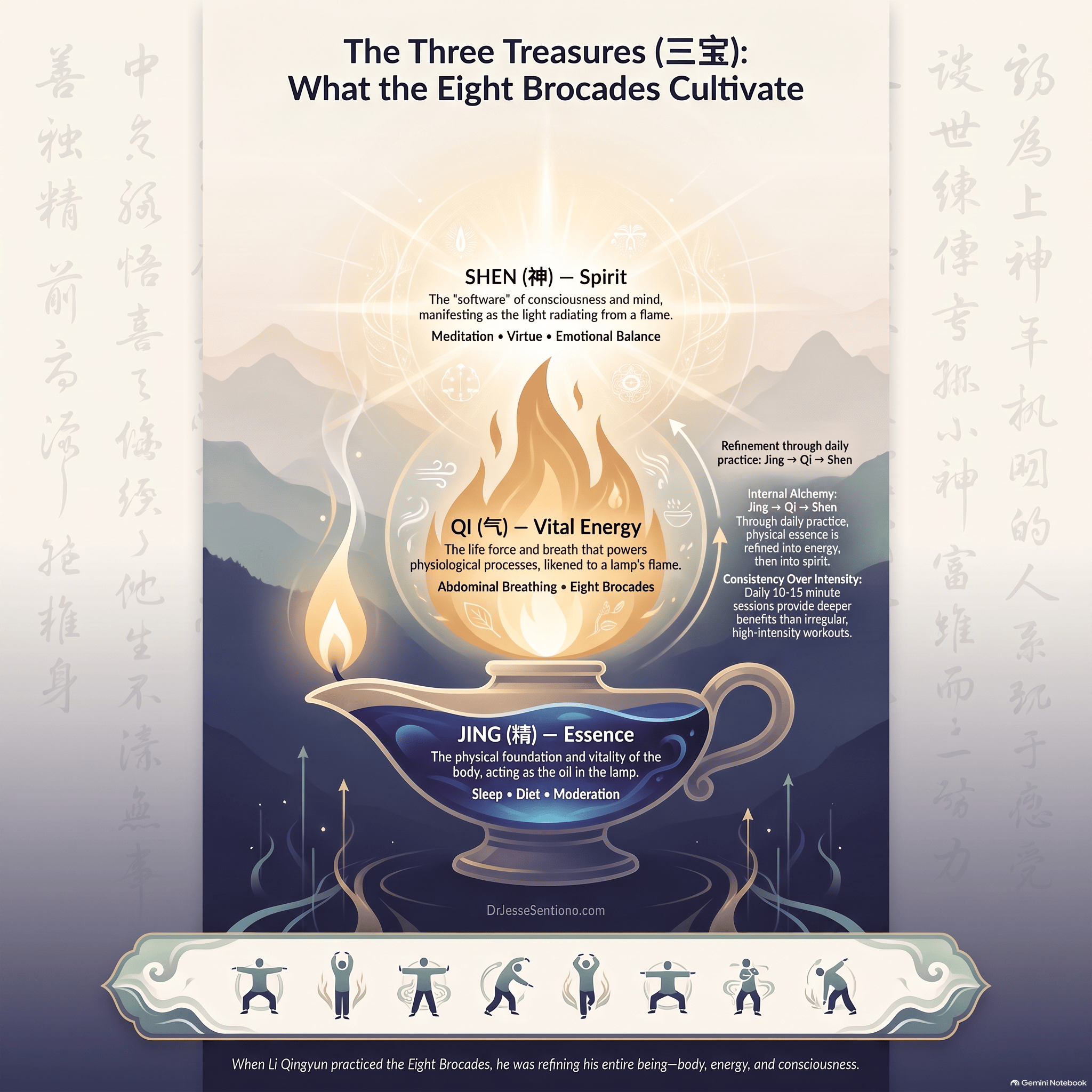
Taoist qigong is built on the concept of the Three Treasures (三宝, San Bao): Jing (essence), Qi (vital energy), and Shen (spirit). Think of them as three layers of your existence—from the most physical to the most subtle.
1. Jing (精) — Essence
What it is: Jing is your body’s fundamental vitality. It is the physical foundation of life—the “hardware” of your existence.
Where it comes from: You are born with a fixed amount of Jing, inherited from your parents. This is called Pre-Heaven Jing (先天精). It determines your constitution, your baseline health, and, to some extent, your natural lifespan.
What it does:
- Supports growth, development, and reproduction
- Maintains the structure of your body (bones, organs, tissues)
- Provides the raw material for all physical and energetic functions
How to preserve it:
- Moderate sexual activity
- Adequate sleep and rest
- A nourishing diet
- Avoiding stress and overwork
- Practicing qigong to “seal” and preserve Jing
The analogy: Jing is like the oil in a lamp. You are born with a certain amount. You can use it slowly or burn it out quickly.
2. Qi (气) — Vital Energy
What it is: Qi is the life force that animates the body. It is the “electricity” that runs through your system.
Where it comes from: Qi is derived from two sources:
- Pre-Heaven Qi: inherited from your parents
- Post-Heaven Qi: extracted from food, air, and water throughout your life
What it does:
- Circulates through the body’s meridians (energy channels)
- Powers every physiological process—digestion, circulation, immune function, thought
- Regulates the flow of blood and fluids
- Protects the body from external pathogens
How to cultivate it:
- Abdominal breathing
- Qigong exercises like the Eight Brocades
- Tai Chi and other internal martial arts
- Meditation
- Proper diet and hydration
The analogy: Qi is like the fuel in an engine. Unlike Jing, it can be continuously replenished.
3. Shen (神) — Spirit
What it is: Shen is consciousness, awareness, and the spiritual essence of a person. It is the “software” that directs the body and mind.
Where it comes from: Shen is rooted in Jing and Qi. When Jing and Qi are strong, Shen is clear and bright. When they are depleted, Shen becomes scattered, dull, or disturbed.
What it does:
- Governs thought, emotion, and intention
- Resides in the heart (the “Heart Shen”)
- Manifests in the light of the eyes
- Directs the flow of Qi and the function of the body
- Connects you to higher consciousness and spiritual realization
How to cultivate it:
- Meditation and mindfulness
- Reducing sensory overload
- Cultivating virtue, compassion, and emotional balance
- Practicing the Eight Brocades and other qigong
- Living with purpose and meaning
- Adequate sleep
The analogy: Shen is like the light in a house. When the wiring (Qi) and the power source (Jing) are good, the light shines brightly.
How the Three Treasures Work Together
The Three Treasures are not separate—they are a continuum, from coarse to subtle:
| Treasure | Nature | Analogy | Source |
|---|---|---|---|
| Jing | Physical | Oil in a lamp | Inherited + conserved |
| Qi | Energetic | Flame of the lamp | Derived from food, air, and practice |
| Shen | Spiritual | Light from the flame | Refined from Jing and Qi |
The classical Taoist formula is:
Jing → Qi → Shen
Through practice, Jing is refined into Qi. Qi is refined into Shen. Shen returns to the Dao (the Source).
This is the process of internal alchemy (Neidan)—not the creation of a physical elixir, but the transformation of your own being into its highest potential.
Why This Matters for Li Qingyun and the Eight Brocades
The Eight Brocades are designed to cultivate all three treasures simultaneously:
- The physical movements strengthen the body and preserve Jing
- The breath coordination builds and circulates Qi
- The mental focus and intention refine Shen
When Li Qingyun practiced the Eight Brocades daily for over 120 years, he was not just exercising his body. He was refining his entire being—body, energy, and consciousness—into a unified whole.
This is why Taoist longevity practices are not merely physical. They address the root of vitality on every level: the physical, the energetic, and the spiritual.
For Li Qingyun, this was not merely an exercise. It was cultivation—a daily investment in the foundation of his vitality.
What Modern Science Says About the Eight Brocades
Li Qingyun’s 250-year lifespan is difficult to verify by modern standards. But the Eight Brocades themselves have been studied extensively, and the research is remarkable.
Cardiovascular Benefits
A 2020 systematic review and meta-analysis published in BMC Complementary Medicine and Therapies pooled data from 14 randomized controlled trials on Eight Brocades and hypertension.
The findings:
- Systolic blood pressure reduction: -8.52 mmHg (compared to control)
- Diastolic blood pressure reduction: -4.65 mmHg
- When combined with routine treatment, the effects were even stronger
A 2026 study from the Chinese Academy of Medical Sciences found that practicing Eight Brocades for three months effectively lowered systolic blood pressure, with effects lasting up to one year—comparable to brisk walking.
Immune Function
A 2014 study examined the effects of 12 weeks of Eight Brocades practice on immune function in elderly participants.
The results showed:
- Significant increases in immune markers, including IgA, IgG, and IgM
- Enhanced NK cell activity (natural killer cells, which fight infections and cancer)
- Improved antioxidant enzyme levels
The study concluded that Eight Brocades “can effectively enhance the elderly’s immune system function” .
Balance and Fall Prevention
For older adults, falls are a leading cause of injury and death. A 2020 feasibility study on Eight Brocades for frail older adults found the practice to be safe and feasible, with the potential to improve physical and cognitive function and reduce fall risk.
An 8-week program showed:
- 24.8% improvement in Timed Up-and-Go tests (a measure of mobility)
- 66.6% increase in single-leg stand time (a measure of balance)
- 33% improvement in heart rate variability (a marker of nervous system health)
Metabolic and Anti-Aging Effects
Research has also shown that Eight Brocades can:
- Lower cholesterol and triglycerides
- Increase HDL (“good” cholesterol)
- Improve antioxidant status by up-regulating antioxidant enzymes
- Reduce oxidative stress, a key mechanism of aging
Why Li Qingyun Practiced Daily
The scientific evidence explains what the Eight Brocades do. But why did Li Qingyun practice them every day for over a century?
The answer lies in the Taoist understanding of cultivation.
Unlike modern exercise, which is often performed in intense sessions a few times per week, qigong is traditionally practiced daily, often in the morning. The goal is not to exhaust the body but to gently and consistently nourish it.
Li Qingyun’s practice was not about achieving a personal record or building muscle. It was about maintaining the free flow of Qi through the body’s meridians, supporting the function of internal organs, and preserving the Three Treasures.
This is a fundamentally different approach to health than what most modern people practice. It is not about pushing the body to adapt. It is about creating the conditions for the body to heal and sustain itself.
The Eight Brocades are simple enough to be performed daily without strain, yet comprehensive enough to address every major system in the body. This makes them an ideal practice for lifelong cultivation.
How to Practice the Eight Brocades Today
You do not need to be a Taoist hermit to benefit from the Eight Brocades. The practice is accessible to anyone, regardless of age or fitness level.
Getting Started
- Learn the movements: The Eight Brocades are widely taught. Look for classes in your area or reputable online instruction.
- Start slowly: You do not need to perform all eight movements perfectly on day one. Master one movement per week, as some instructors recommend.
- Practice daily: Consistency matters more than duration. Even 10-15 minutes per day can produce benefits.
- Focus on breath and intention: The movements are only part of the practice. Coordinate your breath with each movement, and maintain a calm, focused mind.
- Be patient: The benefits accumulate over time. Some changes may appear within weeks, but the deeper effects of qigong cultivation take months and years to fully develop.
🫁 The General Rule for Breath and Movement
The core idea is to coordinate your breath with the expansion and contraction of your body.
- Inhale when you are opening, expanding, rising, or lifting (e.g., raising your hands, expanding your chest, standing up).
- Exhale when you are closing, gathering, lowering, or relaxing (e.g., lowering your hands, returning to a stance, relaxing your shoulders).
- Brief Pause (闭气): Many traditional forms include a momentary, comfortable pause at the peak of the movement—like when your hands are fully raised—to allow the Qi to circulate before exhaling.
Think of it like a wave: the inhale is the cresting of the wave (expansion), and the exhale is the wave washing back down the shore (relaxation).
🧘 Putting It Together with Abdominal Breathing
This is where the practice deepens. The breathing pattern you should use is abdominal (or diaphragmatic) breathing, as we covered in detail in Part 2 of this series. However, the Eight Brocades traditionally use a slightly more advanced version called reverse abdominal breathing (逆腹式呼吸).
Here is the difference in practice:
- Normal Abdominal Breathing: Inhale → belly expands. Exhale → belly contracts.
- Reverse Abdominal Breathing (used in Brocades): Inhale → belly contracts slightly (and you gently lift the perineum). Exhale → belly expands.
The purpose of this reverse pattern is to help lift and circulate the Qi more powerfully with the movement of your arms and body. When your arms rise, the gentle contraction of your abdomen helps guide the breath upward; when your arms lower, the relaxation of your abdomen helps the Qi sink back down to the lower Dantian.
💡 A Note for Beginners
The search results contain an important caution: do not force the breath to match the movement.
Start by simply breathing naturally while learning the movements. Once the physical pattern is comfortable, you can begin to gently link the inhale to the rising movements and the exhale to the lowering movements. The coordination should feel effortless and natural, not rigid or strained.
Safety Considerations
The Eight Brocades are generally safe, but there are important cautions:
- Do not practice on a full stomach or when experiencing low blood sugar
- Stop immediately if you feel dizzy, short of breath, or experience chest pain
- Modify movements as needed for your fitness level—older adults or those with health conditions should use higher stances and gentler motions
- Consult a healthcare provider if you have serious heart conditions or other medical concerns
- Avoid head-down positions if you have high blood pressure or glaucoma
The Eight Brocades are a tool for health, not a competition. The goal is gentle, consistent practice that supports your body rather than strains it.
Conclusion: The Takeaway
Li Qingyun’s daily practice of the Eight Brocades was not a curious historical footnote. It was the engine of his longevity—a simple, sustainable routine that he maintained for over a century.
The modern research confirms what Taoist practitioners have known for centuries: these eight gentle movements can transform your health.
The takeaway:
- The Eight Brocades are a complete mind-body practice that cultivates the Three Treasures: body, breath, and spirit.
- Li Qingyun practiced them daily for over 120 years, demonstrating that consistency, not intensity, is the key to long-term health.
- Scientific research validates the benefits: lower blood pressure, enhanced immune function, improved balance, reduced oxidative stress, and better metabolic health.
- The practice is accessible to everyone, regardless of age or fitness level, and can be modified to suit individual needs.
- Daily practice is more important than perfect form—even 10-15 minutes per day can produce meaningful benefits over time.
- The Eight Brocades are not a quick fix, but a lifelong practice that supports the body’s natural healing and regenerative capacities.
- Start slowly and be patient: Master one movement at a time, coordinate breath with motion, and allow the benefits to accumulate.
- Li Qingyun’s secret was not magic—it was a simple, gentle practice, performed with dedication, day after day, for a very long time.
In a world of high-intensity workouts and quick-fix solutions, the Eight Brocades offer a different path. Not the path of pushing harder, but the path of nourishing consistently. Not the path of exhaustion, but the path of cultivation.
Li Qingyun walked that path for over two centuries. The same path is open to you.
This article is for educational purposes only and is not intended as medical advice. Consult with a qualified healthcare professional before beginning any new exercise program.
Don’t Get Sick!
About Dr. Jesse Santiano, MD
Dr. Santiano is a retired internist and emergency physician with extensive clinical experience in metabolic health, cardiovascular prevention, and lifestyle medicine. He reviews all medical content on this site to ensure accuracy, clarity, and safe application for readers. This article is for educational purposes and is not a substitute for personal medical care.
💡 Support This Work
Creating well-researched articles, maintaining this website, and keeping the information free takes time and resources.
If you found this article helpful, please consider donating to support the mission of empowering people to live healthier, longer lives without relying on medications.
🙏 Every contribution, big or small, truly makes a difference. Thank you for your support!
Follow me on Facebook, Gab, Twitter (formerly known as X), Instagram, and Telegram.
Related:
- The Immortal: Uncovering the Legend of the 250-Year-Old Man, Li Qingyun
- The Immortal’s Breath: How Li Qingyun’s Abdominal Breathing Can Transform Your Health
- The Truth About Adaptogens: Benefits, Risks, and Safe Use
- Unlocking the Secrets of Jiaogulan: A Modern Look at Gynostemma pentaphyllum
- Pu-erh Tea: How a Fermented Ancient Brew Remodels the Gut to Boost Metabolism
- Tight And Tired? Understanding Fascial Contraction—and How To Reverse It
- The Timed Up and Go Test
- Lipid Accumulation Product (LAP): Linked With Type 2 Diabetes, Hypertension, and Mortality Risk
- HDL-Raising Drugs Do Not Improve Cardiovascular and All-Cause Mortality
- 7000 Steps Can Save Your Heart, Brain, And Prolong Life
- Stronger Handgrip, Longer Life: What Science Now Shows
- Reduced Flexibility, Shorter Life? What This 29-Year Study Reveals
- Physical Activity Prolongs Life
- Stunning Low Doses Of Lithium Really Improve Survival
- Your Calf Muscles Could Predict Your Lifespan
- Blue Spaces, Longer Lives: Unlock Nature’s Hidden Advantage
- Low Testosterone, Higher Mortality: What Two Major Studies Reveal About Hormone Health and How to Boost It Naturally
References
Primary Source: Li Qingyun’s Teachings and Biography
Yang, S. (2014). The immortal: True accounts of the 250-year-old man, Li Qingyun (S. A. Olson, Trans.). Valley Spirit Arts. (Original work published 1970)
Olson, S. A. (2002). Qigong teachings of a Taoist immortal: The eight essential exercises of Master Li Ching-yun. Healing Arts Press.
Historical Context and Origins
Gao, L. (Ming Dynasty). Eight letters on how to comply with the health preserving and care (遵生八笺). [As cited in British Health Qigong Association, n.d.]
Hong, M. (Southern Song Dynasty). Yi Jian Zhi (夷坚志). [As cited in British Health Qigong Association, n.d.]
Zeng, Z. (Southern Song Dynasty). Taoism Essence (道枢), Vol. 35. [As cited in British Health Qigong Association, n.d.]
Cardiovascular Effects
Ma, Z., Lei, H., Tian, K., Liu, Z., Chen, Y., Yang, H., & Zhu, X. (2022). Baduanjin exercise in the treatment of hypertension: A systematic review and meta-analysis. Frontiers in Cardiovascular Medicine, *9*, 936018. https://doi.org/10.3389/fcvm.2022.936018
Li, L., et al. (2022). Network meta-analysis of the antihypertensive effect of traditional Chinese exercises on patients with essential hypertension. Journal of Healthcare Engineering, *2022*, 9419037. https://doi.org/10.1155/2022/9419037
Ma, J., et al. (2023). The effect of traditional Chinese exercises on blood pressure in patients with hypertension: A systematic review and meta-analysis. Evidence-Based Complementary and Alternative Medicine, *2023*, 2897664. https://doi.org/10.1155/2023/2897664
Immune Function and Inflammation
Ismail, A. M. A., et al. (2025). Effect of baduanjin exercise on salivary inflammatory and oxidative markers in the elderly with metabolic syndrome and periodontal disease: A randomized trial. Journal of Bodywork and Movement Therapies, *45*, 536–544. https://doi.org/10.1016/j.jbmt.2025.09.017
Oxidative Stress and Aging
Chen, D., et al. (2022). Effects of traditional Chinese exercise on oxidative stress in middle-aged and older adults: A network meta-analysis. International Journal of Environmental Research and Public Health, *19*(14), 8388. https://doi.org/10.3390/ijerph19148388
Balance and Fall Prevention
Yu, Y.-G., et al. (2025). Comparative study of Baduanjin and brisk walking on balance and stability in older adults. Experimental Gerontology, *201*, 112687. https://doi.org/10.1016/j.exger.2025.112687
Zhang, H., et al. (2026). Exploring the mechanism of reducing the risk of falls in knee osteoarthritis patients by using Baduanjin based on the functional connection of vestibular network: A study protocol for a randomised controlled trial. BMJ Open, *16*(6), e114318. https://doi.org/10.1136/bmjopen-2025-114318
Xiao, Y., et al. (2021). Effect of baduanjin on the fall and balance function in middle-aged and elderly people: A protocol for systematic review and meta-analysis. Medicine, *100*(37), e27250. https://doi.org/10.1097/MD.0000000000027250
Theoretical Framework: The Three Treasures
Acupuncture Regulatory Authority. (2023, January 2). The Three Treasures – Jing, Shen and Qi. https://acupunctureregulatoryauthority.org.uk/the-three-treasures-jing-shen-and-qi/
Disclaimer:
This article is for educational purposes and is not a substitute for professional medical advice, diagnosis, or treatment. Always consult your physician before making health decisions based on the TyG Index or other biomarkers.
© 2018 – 2026 Asclepiades Medicine, LLC. All Rights Reserved
DrJesseSantiano.com does not provide medical advice, diagnosis, or treatment
As an Amazon Associate, I earn from qualifying purchases
Discover more from Don't Get Sick!
Subscribe to get the latest posts sent to your email.